You pull your favorite leather jacket out of the closet, and something looks off. Green patches are creeping along the sleeves, near the collar, or spreading across the back in dusty, blotchy clusters. It doesn’t look like normal wear; it looks like something went wrong. It did, but the good news is that most cases of a leather jacket turning green are completely fixable if you know exactly what you’re dealing with first.
What Causes a Leather Jacket to Turn Green?
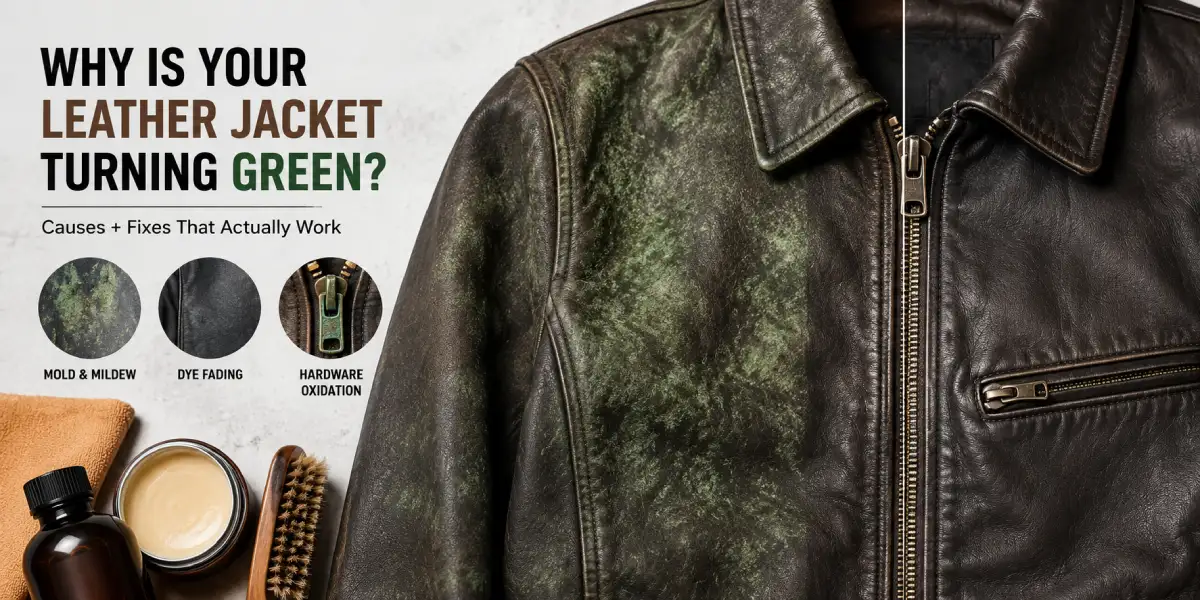
Green discoloration on leather doesn’t have one single cause. It has three. And the fix for each one is completely different, so correctly diagnosing your jacket before you reach for a cloth or a product matters a lot.
The Three Root Causes at a Glance
Your jacket is turning green because of one of three things: active mold or mildew feeding on the leather’s surface, natural black dye breaking down under UV light and shifting toward a greenish-blue tone, or the copper and brass hardware on your jacket oxidizing and staining the surrounding leather.
Each of these problems looks slightly different. Mold tends to appear as fuzzy, powdery patches, often clustered in one area and occasionally carrying a musty smell. Dye fade, on the other hand, shows up as a gradual, even shift in color, especially across high-friction zones like the shoulders, cuffs, and back. Metal-related greening appears right at the source: around the zipper track, snaps, buckles, or any brass-tone hardware touching the leather directly.
Spot the pattern, and you’ll already know which fix applies to you. So let’s go through each cause in full.
Mold — The Most Common Reason and How to Remove It
Green mold on a leather jacket is not rare. It happens fast, especially if you’ve stored your jacket in a wardrobe with poor airflow, a basement, or any space where humidity sits above 60 percent. Leather is porous. It breathes, absorbs moisture from the air, and when those conditions are warm and damp enough, mold finds exactly the environment it needs to take hold.
How to Identify Mold on Your Leather Jacket?
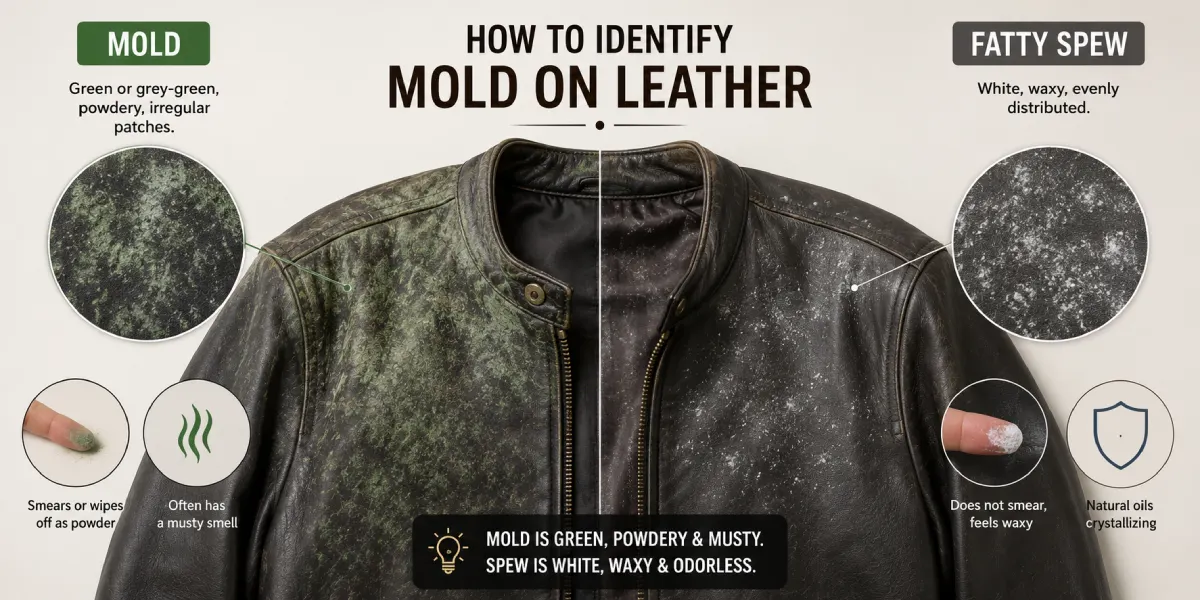
Mold on leather usually appears as soft, powdery, dusty-looking green or grey-green clusters. Sometimes it covers a wide area. Sometimes it’s concentrated around the lining, the collar, or the inside pocket: spots that rarely get airflow. Run a finger lightly across it. If it smears or wipes off in a powdery residue, you’re almost certainly dealing with mold or mildew growth, not a dye issue.
One common mistake people make is confusing mold with fatty spew. Fatty spew, also called fat bloom, is a completely different phenomenon where natural fats and oils from within the leather crystallize on the surface as the hide adjusts to temperature changes. Spew is typically white, waxy, and evenly distributed. Mold is green or grey-green, irregular in shape, and often smells musty. Knowing which one you have matters because treating spew with mold remover will damage the leather’s finish unnecessarily.
How to Remove Green Mold from Leather Jacket at Home?
Mold on leather usually appears as soft, powdery, dusty-looking green or grey-green clusters. Sometimes it covers a wide area. Sometimes it’s concentrated around the lining, the collar, or the inside pocket: spots that rarely get airflow. Run a finger lightly across it. If it smears or wipes off in a powdery residue, you’re almost certainly dealing with mold or mildew growth, not a dye issue.
One common mistake people make is confusing mold with fatty spew. Fatty spew, also called fat bloom, is a completely different phenomenon where natural fats and oils from within the leather crystallize on the surface as the hide adjusts to temperature changes. Spew is typically white, waxy, and evenly distributed. Mold is green or grey-green, irregular in shape, and often smells musty. Knowing which one you have matters because treating spew with mold remover will damage the leather’s finish unnecessarily.
How to Remove Green Mold from Leather Jacket at Home?
Start by taking the jacket outside or into a well-ventilated space. You don’t want to spread mold spores through your home. Using a dry microfiber cloth, gently brush away as much of the surface mold as you can without pressing it deeper into the leather grain.
Next, mix a solution of equal parts cool water and isopropyl rubbing alcohol. This combination is gentle enough for most finished leathers while being strong enough to neutralize active mold. Dampen a clean microfiber cloth with this solution and wipe the affected areas using light, circular motions. Don’t saturate the leather. You’re treating the surface, not soaking the hide.
Let the jacket air dry completely in a well-ventilated space, away from direct sunlight and away from any heat source. Once it’s fully dry, apply a good quality leather conditioner, something like Leather Honey or Saphir Renovateur, to restore the moisture the cleaning process draws out. Conditioning is not optional here. Leather that dries out after leather jacket mold removal at home becomes brittle and prone to cracking.
For stubborn mold that keeps coming back, a leather-safe antifungal cleaner like Nikwax Leather Wash applied before conditioning gives you a stronger, longer-lasting kill on the spores.
Related Read:Leather Jacket Cleaning Tips, a full step-by-step guide covering tools, techniques, and what to avoid.
Black Dye Fading to Green: What is Actually Happening
This one surprises most people. Your jacket started as a rich, deep black. Now it’s taken on a greenish-blue cast, not from mold, not from hardware, but from the dye itself slowly failing. It’s one of the most misdiagnosed causes of green discoloration on leather, and it’s surprisingly common on jackets that see regular outdoor use.
Why Does Black Leather Dye Turn Greenish Over Time?
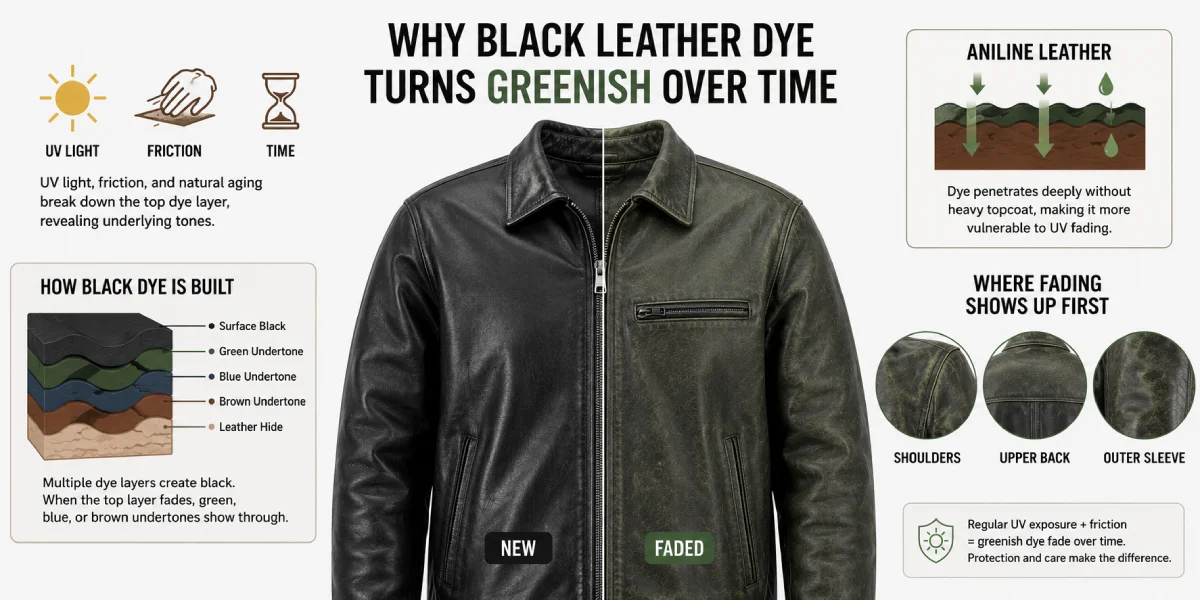
A black leather jacket turning green isn’t always about mold. Black leather dye is rarely a pure single-pigment compound. Most black leather finishes achieve their color by layering multiple dye components together, and several of those underlying components carry green, blue, or brown undertones beneath the surface black. When UV light, friction, and natural aging break down the topmost dye layer, those underlying tones start bleeding through.
This is especially true for aniline-dyed leather, where the dye penetrates the hide without a heavy protective topcoat. Aniline jackets feel incredible: soft, natural, and rich. But that openness also makes them more vulnerable to sun-related leather dye fading green than semi-aniline or pigmented leather. If your jacket feels buttery soft, has a very natural grain, and has spent regular time in direct sunlight or been worn outdoors, dye fade is the most likely cause of the green tint you’re seeing.
You’ll also notice that dye fade tends to appear first on the shoulders, the upper back, and the outer sleeve: the surfaces that take the most UV exposure while you’re wearing the jacket.
How to Fix a Leather Jacket with Faded Dye?
You can’t reverse UV damage to the existing dye, but you can restore the color using a leather dye or color restorer applied to the affected areas. Saphir Leather Dye in black is widely regarded as the best consumer-grade option for this. Clean the jacket thoroughly first, then apply thin, even coats of the dye using a soft sponge or horsehair brush, working with the grain. Two or three light coats build up truer coverage than one heavy application.
Follow the dye with a black leather cream. Saphir Creme 1925 in Noir is excellent for this, as it seals the surface, nourishes the fibers, and gives the jacket a soft, natural finish rather than a painted, over-saturated look.
Once the color is restored, finish with a UV-protective leather conditioner. This is your insurance policy against the same fading happening again.
Important: Want to understand how quality leather develops character over time? Read our Patina Leather Guide to see why genuine leather aging is actually a feature, not a flaw.
Metal Hardware Reacting with Leather: The Hidden Cause
This is the cause nobody talks about. And it’s also the one that catches people completely off guard, because the green staining seems to appear out of nowhere, usually right around the zipper, near the snap buttons, or along any area where copper-alloy or brass hardware sits in direct contact with the leather.
The Verdigris Reaction: What’s Really Happening
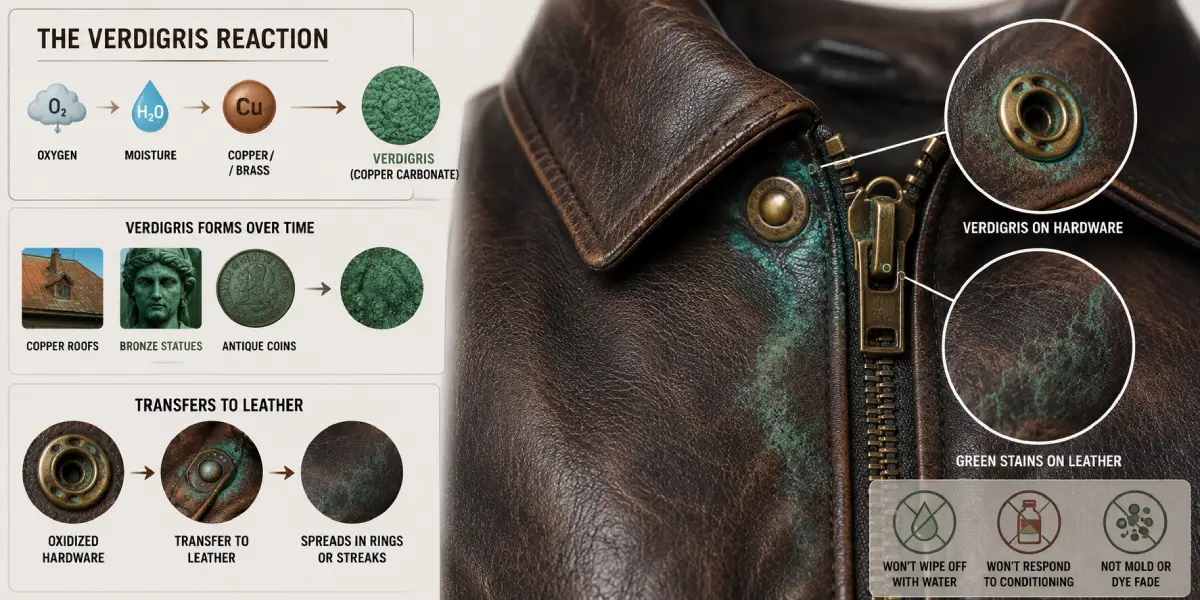
Copper, brass, and many copper-alloy hardware components all share one chemical behavior: when exposed to oxygen and moisture over time, they oxidize. That oxidation process produces a compound called verdigris, a copper carbonate that’s distinctly blue-green in color. You’ve seen verdigris before. It’s the green patina that forms on old copper roofs, bronze statues, and antique coins.
On your leather jacket, the verdigris doesn’t stay on the hardware. It transfers directly onto the surrounding leather, especially where friction or moisture acts as a catalyst for that transfer. The tannins naturally present in vegetable-tanned leather actually accelerate this reaction. They’re mildly acidic, and that acidity speeds up the copper oxidation process significantly.
The result is leather jacket green spots that spread outward from the hardware in an irregular ring or streak pattern. It won’t wipe off with water. It won’t respond to conditioning. That’s how you know it’s a verdigris transfer rather than mold or dye fade.
How to Treat Copper-Stained Leather?
The most effective approach uses a mild acidic cleaner, diluted white vinegar works, though a leather-safe copper stain remover is more controlled, applied with a cotton pad to the stained area only. Work gently, in small circular motions, and wipe clean with a damp cloth immediately after. Then condition the area thoroughly, because any acid-based cleaning strips moisture from the leather fiber very quickly.
Long-term, though, the fix isn’t just treating the stain. It’s changing the hardware. Replacing copper-alloy or brass zippers and snaps with nickel or stainless hardware removes the root cause entirely. A leather specialist or tailor can handle this swap on most jackets without disturbing the rest of the construction.
If replacement isn’t an option, applying a thin layer of clear leather wax or a paste conditioner to the leather areas directly adjacent to all hardware creates a barrier that slows, though doesn’t completely stop, the verdigris transfer over time.
For a deeper look at restoring surface damage, check out our guide on Fix Scratched Leather at Home. The same careful approach applies to both scratch repair and stain treatment.
How to Prevent Your Leather Jacket from Turning Green?
Once you’ve fixed the problem, keeping it fixed comes down to a few consistent habits. None of them is complicated. But skipping them is exactly how a jacket ends up back in this situation.
Storage Habits that Stop Mold Before it Starts
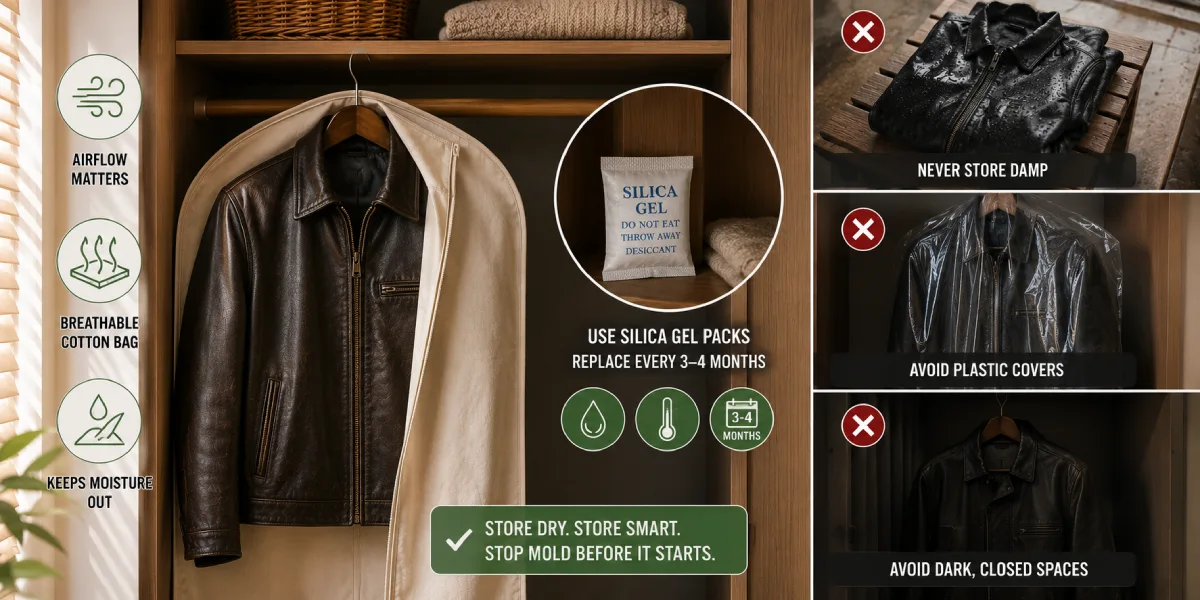
Where you store your jacket matters more than almost anything else. Hanging it in a dark, enclosed wardrobe with limited airflow is one of the most common reasons how to prevent mold on leather jacket situations develop in the first place. Instead, store the jacket in a breathable cotton garment bag, never plastic, which traps moisture, in a space where air can circulate freely.
If you live in a humid climate or if your storage area experiences temperature swings, a small silica gel dehumidifier pack placed near the jacket actively pulls excess moisture from the air. Replace the packs every three to four months. It’s a cheap fix that prevents an expensive problem.
Never store a damp or even slightly moist jacket. After rain or heavy wear, hang the jacket on a wide, padded hanger in a ventilated room until it’s completely dry before putting it away. Folding or packing a damp jacket, even briefly, gives mold a perfect dark, warm, humid environment to establish itself rapidly.
Conditioning and Care: A Simple Seasonal Schedule
Leather needs moisture to stay healthy. A conditioned jacket is a jacket that resists mold, resists dye breakdown, and resists hardware staining, all at once, because a well-fed leather surface doesn’t have the micro-cracks and porous gaps that allow moisture, UV damage, or metal oxidation to penetrate deeply.
Condition your jacket every three months during regular use, or every time it gets wet. Apply a generous but not excessive coat of a quality conditioner: Leather Honey, Saphir Renovateur, or Pecard’s Leather Cream are all reliable choices. Work it in evenly with a soft cloth and focus on high-friction zones like the shoulders, cuffs, and the collar, where the dye layer wears fastest.
Twice a year, take a closer look at every piece of metal hardware on the jacket. If you spot early signs of oxidation, a dull, slightly greenish tint developing on what should be bright brass or copper, wipe the hardware down with a dry cloth and apply a small amount of metal polish to keep the reaction from advancing.
If you want to go further with leather care and surface refinement, our Leather Burnishing Guide explains how professional burnishing techniques seal edges and surfaces for long-term protection. This specialized edge-finishing process smooths out raw, exposed fibers and locks out destructive ambient moisture, making it an incredibly useful extra step to shield your gear from future discoloration or environmental wear.
Your Jacket Isn’t Done Yet
A leather jacket green spots isn’t always the end of the story. In fact, catch it early enough, whether it’s mold, dye fade, or verdigris creeping out from the zipper, and your jacket comes back looking better than it did before the problem started. The care process itself re-nourishes the leather, deepens the color, and adds to the kind of character that a well-maintained jacket builds over the years. And if you notice white patches showing up alongside the green, that’s a separate issue worth understanding too. Our guide on Why Is My Leather Jacket Turning White breaks down exactly what causes that and how to fix it. That’s the thing about genuine leather. It doesn’t just survive attention. It rewards it.
Not necessarily. While active mold is usually the main culprit, those green marks can also come from old black dyes wearing thin under the sun, or a green chemical crust called verdigris bleeding directly off your copper or brass zippers.
Yes, diluted white vinegar works wonders for clearing away surface mold and metal stains. Just make sure you follow up with a good conditioner immediately afterward, because the natural acid will strip away moisture and leave the hide pretty dry.
Most black leather dyes aren’t just one single color; they’re made by mixing deep blue and green pigments together. When the top black finish wears down from sunlight and daily friction, those hidden green undertones start showing through to the surface.
About Author:
Caleb Norton is an experienced leather industry writer with over five years of expertise in product care, durability, and modern style guidance.


 TRACK YOUR ORDER


